 By the Vietnam Expat team. Last reviewed 2026-09-21
How bad is the air in Vietnam?
Vietnam averaged 29.7 µg/m3 of PM2.5 in 2025, which is 5.9 times the WHO guideline and 18th worst of the 143 countries IQAir ranked [4]. The average rose 4 percent from 2024, and only Indonesia, at about 30, was higher in Southeast Asia [1].
PM2.5 means particles 2.5 micrometers across or smaller, and the figure counts micrograms in a cubic meter of air [5]. The WHO guideline is 5 a year and 15 over 24 hours [2].
Vietnam's own limits are looser. The national standard, QCVN 05:2023/BTNMT (a quy chuan ky thuat quoc gia, or national technical regulation), allows 25 a year and, since 1 January 2026, 45 over 24 hours [5].
Only 13 countries and territories met the WHO yearly guideline in 2025, so 130 of the 143 did not (our subtraction) [1]. Being above 5 puts Vietnam with most of the world. Five of the ten most polluted cities in Southeast Asia were Vietnamese [1].
What is the least polluted city in Vietnam?
Hue had the lowest yearly PM2.5 average we found, 11.6 µg/m3 in 2025, and Da Nang came next at 14.9 [1]. Both are still above the WHO guideline of 5 [2].
| City | 2025 PM2.5, µg/m3 [1] | Times the WHO guideline | Under Vietnam's yearly limit of 25? |
|---|---|---|---|
| Hue | 11.6 | 2.3 | Yes. |
| Da Nang | 14.9 | 3.0 | Yes. |
| Saigon (Ho Chi Minh City) | 21.5 | 4.3 | Yes. |
| Hai Phong | 27.1 | 5.4 | No. |
| Hanoi | 45.9 | 9.2 | No. |
| Van Giang | 46.6 | 9.3 | No. |
| Bac Ninh | 48.7 | 9.7 | No. |
| Thai Nguyen | 56.4 | 11.3 | No. |
Source: IQAir 2025 World Air Quality Report, as reported by VnExpress International on 2026-04-13 [1]. The multiples are our division, an estimate. The limit is from QCVN 05:2023/BTNMT [5].
Thai Nguyen, Bac Ninh and Van Giang are industrial hubs in the north. They ranked 51st, 83rd and 97th among Asian cities, and Hanoi 107th [1]. We found no yearly average for Da Lat, Nha Trang, Phu Quoc or Quy Nhon, so we rank none of them.
We would not read the 3.3 µg/m3 gap between Hue and Da Nang as a firm ranking (our subtraction). IQAir's Hue page shows no station count and still quotes a 2019 average of 28.6 µg/m3 [8]. Its Da Nang page lists 3 stations from 3 contributors, and its Hanoi page about 50 [6][7].
Is the air cleaner in Saigon than in Hanoi?
Yes, about half as polluted. IQAir measured 21.5 µg/m3 for Ho Chi Minh City in 2025 against 45.9 for Hanoi, a ratio of 2.1 by our division [1]. Saigon is the everyday name for Ho Chi Minh City.
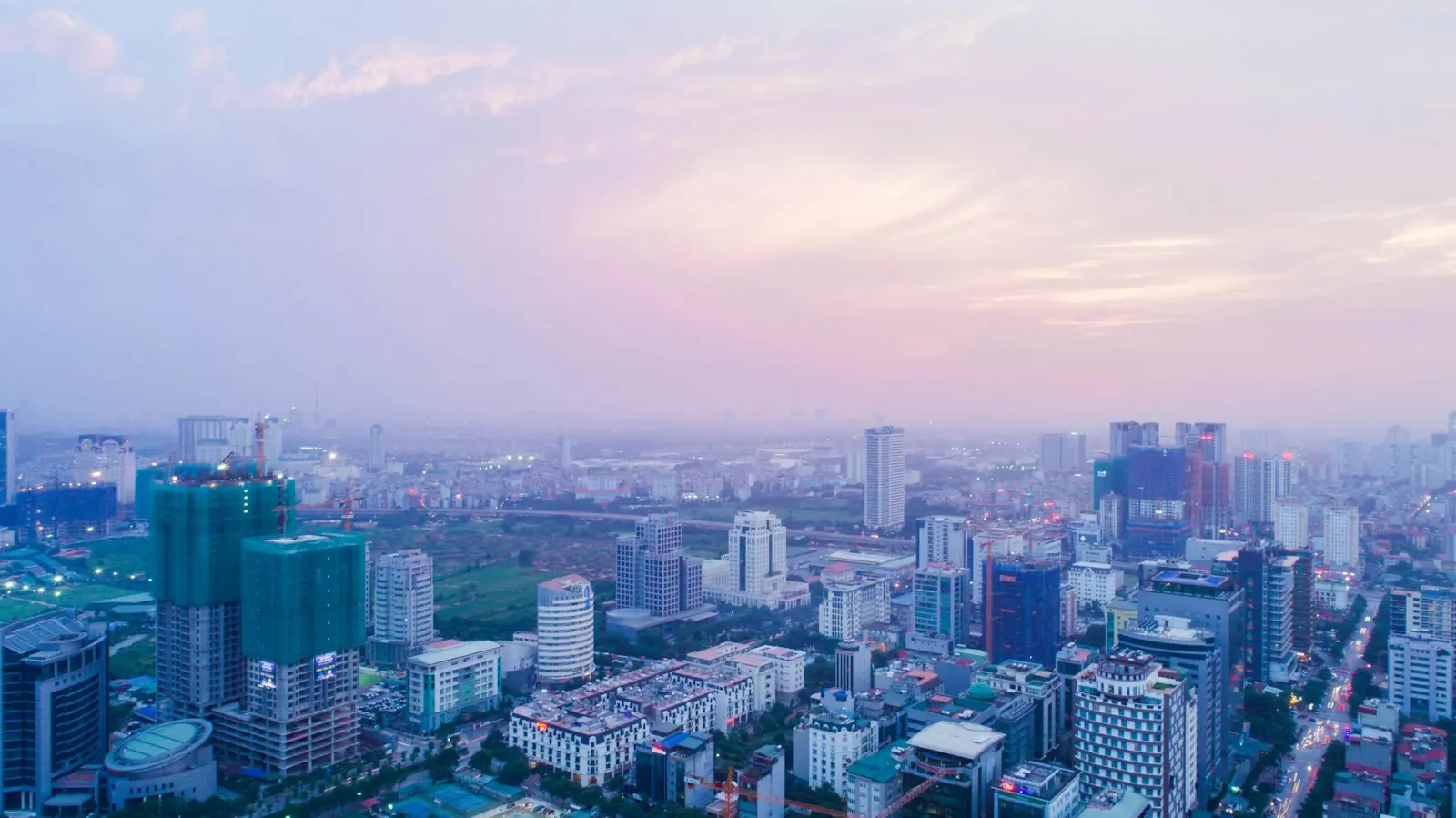
Neither city improved. Saigon's average rose from 20.9 in 2024, and IQAir's report counted 2025 as Hanoi's sixth straight year of worsening air [1].
Ho Chi Minh City's own 2025 report was less comfortable than its yearly average. PM2.5 exceeded the national standard by 1.1 to 4.6 times at some traffic and industrial points [9]. Our Hanoi air quality by month, cause and station and Ho Chi Minh City air quality by month and cause guides go deeper on each.
When is the air worst in Vietnam?
In Hanoi the worst months are December and January, inside a pollution season that runs from October to about March [1][3]. In Saigon the dry season is worse [10][11].

| Place | Worse months | Time of day | Source |
|---|---|---|---|
| Hanoi | October to about March, peak in December and January. | Night into morning on cold, dry days. | [3][1] |
| Saigon | October to March, and higher in the dry season. | 7 to 8 am highest, 15:00 to 16:00 lowest. | [10][11] |
| Da Nang and Hue | No official pattern found. | None found. | We found none. |
Source: Hanoi government portal (2025-12-08), IQAir report via VnExpress International, Thanh Nien (2025-10-30) and a 2021 Saigon study, read 2026-09-21 [3][1][10][11].
The Saigon study found the dry months, January to April and December, about 1.5 times higher than the rainy months, May to November [11]. Hanoi's portal says summer is cleaner because strong winds and heavy rain disperse emissions [3].
Bad days still happen out of season. At noon on 15 September 2026 the Ministry of Agriculture and Environment's station at 200 Ly Chinh Thang street in Saigon read AQI 151, in the bad band [12]. Thanh Nien quoted unnamed meteorology and environment experts, who blamed heavy rain that raised humidity and kept fine dust from dispersing [12].
What causes the pollution?
Traffic, industry, construction and burning, in a mix that changes by city. IQAir names vehicle emissions, coal combustion, biomass burning, construction dust and industrial activity for Vietnam as a whole [1].
For Hanoi and its neighbors the national Environment Administration names four groups: transport, construction, industry with recycling craft villages, and household burning of waste and straw [3]. Hanoi has nearly 7 million motorbikes [1].
A 2021 report by Hanoi's environment department and the World Bank estimated that only about a third of the city's PM2.5 comes from local sources [14]. The rest drifts in from the wider region and beyond [14]. That figure rests on 2015 emissions.
In Saigon the city's monitoring points to road traffic as the main source [13]. The city, now including the former Binh Duong and Ba Ria-Vung Tau, has about 12.82 million motor vehicles [15].
A consultant's estimate for the low emission zone plan puts motorbikes at 95 percent of vehicles but 17.7 percent of the fine dust, and trucks at 3 percent of vehicles but 43.1 percent [15].
Is Vietnam's air quality getting better?
Not yet, in the yearly numbers. Vietnam's 2025 average rose 4 percent, while Indonesia's fell 16 percent, Laos's 18 and Cambodia's 17 [1]. Hanoi's PM2.5 has risen every year since 2020 [1].
The rules are tightening. Since 1 January 2026 the national 24-hour PM2.5 limit is 45 µg/Nm3, down from 50 [5].
The national plan for 2026 to 2030, Decision 2530/QD-TTg of 19 November 2025, sets Hanoi a yearly PM2.5 target of under 40 µg/m3 by 2030 at the national stations. That is a 20 percent cut from the 2024 average [16].
Hanoi's low emission zone began on 1 July 2026 with no blanket ban [17]. Phase 1 covers Areas 1 and 2 of Hoan Kiem ward, and all road vehicles are barred from Area 1 from 19:00 to 24:00, Friday to Sunday [17]. Phase 3, in 2028 and 2029, covers all of Ring Road 1 [17].
Saigon plans a pilot low emission zone of about 16.6 km2 in the core and Thu Thiem from July 2027 [15].
What do the bands in a Vietnam air quality guide mean?
Under Decision 1459/QD-TCMT of 2019, Vietnam's official air quality index, VN_AQI, has six bands, from good at 0 to 50 up to hazardous at 301 to 500 [18]. A day's PM2.5 value is a 24-hour average, and it reads 50 at 25 µg/m3, 100 at 50, 150 at 80 and 200 at 150 [18].
IQAir shows the US EPA scale instead [20]. It is stricter. At 50 µg/m3 over 24 hours VN_AQI reads 100, the top of moderate, while the US scale calls the same air unhealthy for sensitive groups [18][19].
Check which index a number uses before you compare it with Vietnam's official guidance.
Where do you check the air near an address?
Start with Hanoi's city portal, moitruongthudo.vn, which shows AQI by measurement point on the Vietnamese scale [29]. IQAir shows the US scale [20], and Saigon's two stations run by the Ministry of Agriculture and Environment publish at cem.gov.vn [13].
Those two Saigon stations are in the center and in the former Thu Duc City. The city's own program measures 36 points, but only for 7 consecutive days a month [13].
Use the station closest to the address, because readings differ across one city on the same night. Within half an hour on the evening of 7 December 2025, Hanoi's stations read from AQI 152 at Nhan Chinh Park to AQI 295 at Quang Khanh [3].
Networks differ too. On the morning of 20 January 2025 the national stations in Hanoi read 175 to 232, while three private sensors read 291 to 447 [21].
What do official sources tell people to do on a bad day?
Vietnam's official index, VN_AQI, grades every band from good to hazardous and gives each one its own activity guidance, under Decision 1459/QD-TCMT [18]. That guidance sits in the source table, not on this page.
The Ministry of Health's Department of Disease Prevention published its own advisory in December 2025, pointing people to official air quality information from the Ministry of Agriculture and Environment and provincial departments [30].
Canada's travel advice, updated 19 October 2026, says smog and other air pollution can be hazardous in urban areas, that agricultural burning can affect rural air, and that levels can change quickly [22].
The UK Foreign Office lists air pollution among Vietnam's health risks and points travelers to TravelHealthPro [23]. We do not give health advice. Questions about a condition, a child or an older parent belong with a doctor.
Can you escape the noise and pollution by choosing where to live?
Only partly. On the data we have, Hue and Da Nang are the places to start a search for cleaner air, but noise follows roads and industry in every region we could read.
For air, Hue (11.6 µg/m3) and Da Nang (14.9) have the lowest averages we found, and the northern industrial hubs the highest [1]. Inside a city, place still matters. In the 2021 Saigon study two Binh Chanh sites near industrial zones ran about 2.5 times higher than the rest [11].
The trade-off on the coast is rain. Da Nang averages 2,399 mm of rain a year, and 75 percent of it falls from September to December (our sums of the WMO 1991 to 2020 monthly averages) [24]. Our Vietnam climate by month page covers storms and flood months.
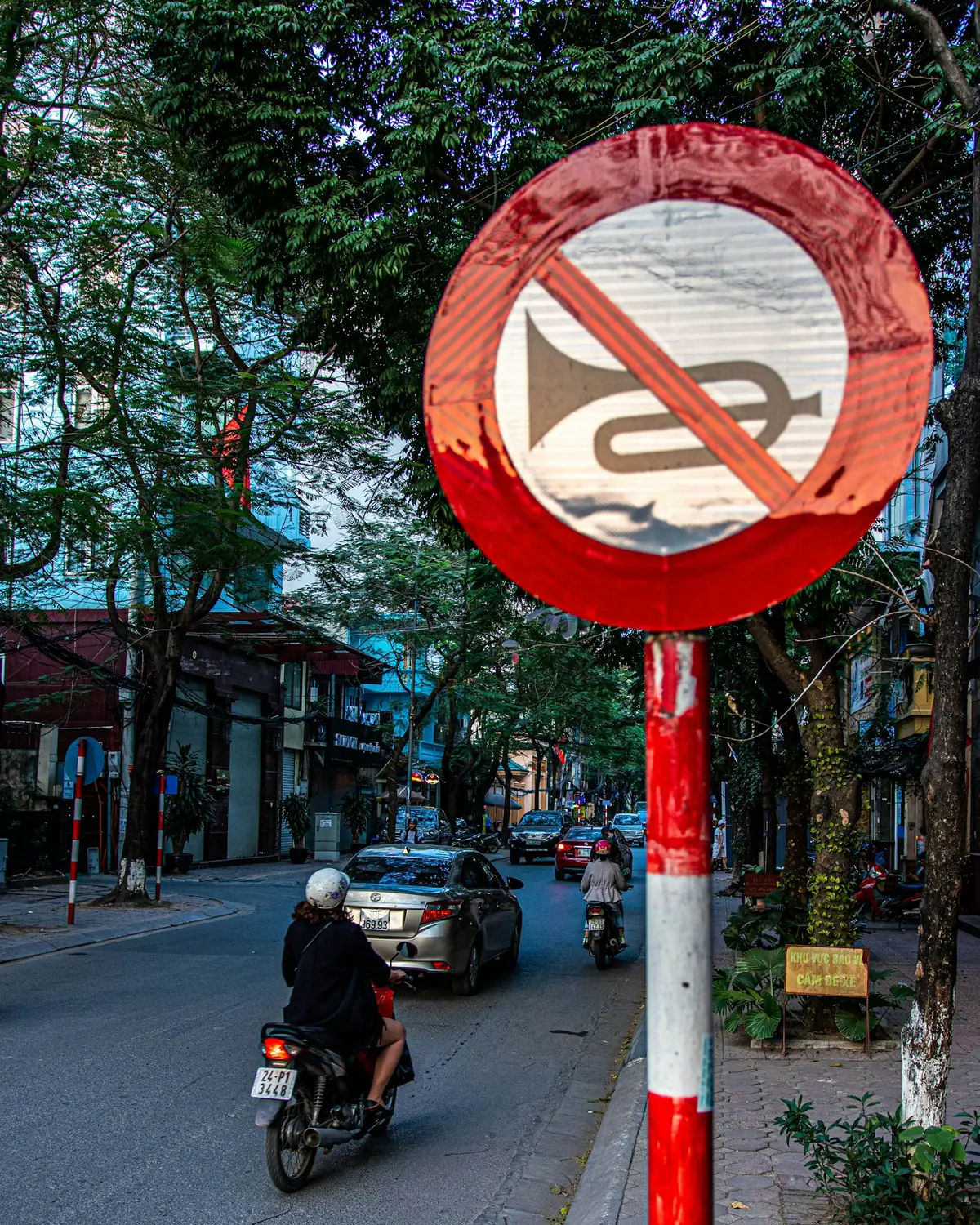
For noise, junctions and industrial zones are the loud points in the official rounds [25][31]. In the central region's round 7 of 2024, 16 of 33 points were above the old 70 dBA limit [25].
The southern region's round 9 of 2024 named urban traffic junctions among its points above the old 70 dBA limit, with Ngã ba Vũng Tàu at 79.9 dBA [31].
The central round's highest point was the west Lien Chieu Industrial Zone in Da Nang, at 81.7 dBA [25]. Saigon's 2025 report says noise still exceeded thresholds on main traffic routes [9].
What noise limits apply at a Vietnamese home?
The national standard, QCVN 26:2025/BNNMT, allows ordinary neighbor and business noise of 55 dBA by day, 50 dBA in the evening and 45 dBA at night at a home [26].
| Class B home, dBA [26] | Day 06:00 to 18:00 | Evening 18:00 to 22:00 | Night 22:00 to 06:00 |
|---|---|---|---|
| Ordinary business or household noise. | 55 | 50 | 45 |
| Karaoke, bar, restaurant, gym or music school in your building. | 50 | 45 | 40 |
| Building site at work. | 65 | 60 | 50 |
Source: QCVN 26:2025/BNNMT, Tables 1 and 3, class B, read 2026-09-21 [26]. Road traffic at a home is capped at 68 dBA from 06:00 to 22:00 and 58 dBA from 22:00 to 06:00 [26].
The standard treats apartment buildings, houses, hotels and guest houses as class B [26]. It replaced the 2010 standard on 14 November 2025, and existing facilities may keep the old one to the end of 2026 [27]. Our national noise limits and fines guide has the rest.
What should you check before you sign a lease?
Check the nearest station in the bad months, then check the address itself at night.
- The season. Hanoi's worst months are December and January, and Saigon's PM2.5 tends to rise from October to March [1][10]. A visit then shows the hard case.
- The hour. Saigon's air peaked at 7 to 8 am in the 2021 study, and Hanoi's is worst from night into morning on cold, dry days [11][3]. Noise limits are tightest from 22:00 to 06:00 [26].
- The neighbors. Look for industrial zones, junctions, building sites and karaoke bars in your building, the loudest sources in the official readings and limits [25][26][31].
- The station. Note its name, because two Hanoi stations differed by 143 AQI points on one evening [3].
A December or January week in Hanoi, or a dry-season week in Saigon, shows the hard case that a yearly average hides. What we still cannot say is how Da Nang, Hue or Da Lat compare month by month, because we found no official monthly series for them.